

Clover can spread quickly across a lawn, creating patches of three-leaf plants and small white flowers that stand out against your grass. While some homeowners welcome clover because it attracts pollinators, others prefer a uniform, green lawn without broadleaf weeds. If clover is taking over your yard, the good news is that you can manage it with the right combination of weed control and lawn care.
The best way to get rid of clover in your lawn is to remove or treat existing plants while improving the growing conditions for your grass. Proper fertilization, appropriate mowing, consistent watering, and targeted weed treatments can help control clover and reduce the chances of it returning.
In this guide, we'll explain why clover grows in North Texas lawns, how to remove it, and what you can do to maintain thicker, healthier turf.
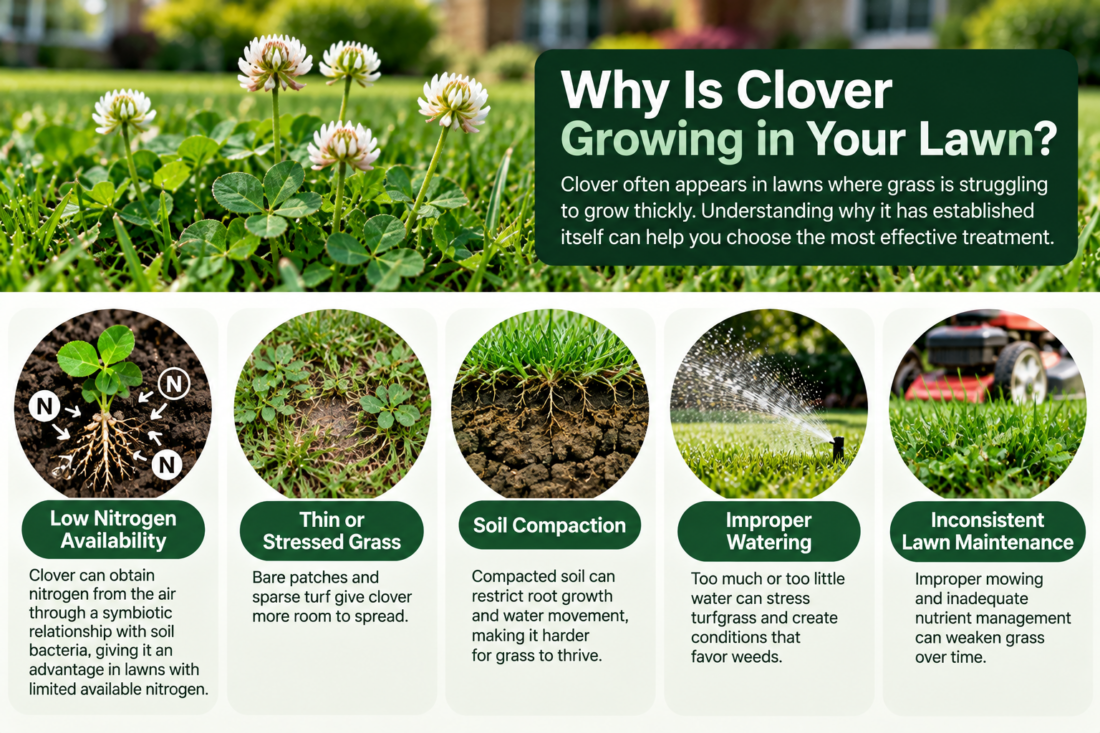
Why Is Clover Growing in Your Lawn?
Clover often appears in lawns where grass is struggling to grow thickly. Understanding why it has established itself can help you choose the most effective treatment.
Common reasons clover grows in lawns include:
-
Low nitrogen availability: Clover can obtain nitrogen from the atmosphere through a symbiotic relationship with soil bacteria. This gives it an advantage in some lawns where grass lacks sufficient available nitrogen.
-
Thin or stressed grass: Bare patches and sparse turf give clover more room to spread.
-
Soil compaction: Compacted soil can restrict root growth and water movement, making it harder for grass to thrive.
-
Improper watering: Too much or too little water can stress turfgrass and contribute to conditions that favor weeds.
-
Inconsistent lawn maintenance: Improper mowing and inadequate nutrient management can weaken grass over time.
Soil pH can also influence grass growth and nutrient availability, but clover alone doesn't necessarily mean your soil is too acidic or that it needs lime.
Rather than focusing only on the visible weeds, evaluate the overall condition of your lawn. Addressing the underlying problems can help your grass compete more effectively with clover.
For more information, learn how to loosen compacted soil.
1. Fertilize Your Lawn Properly
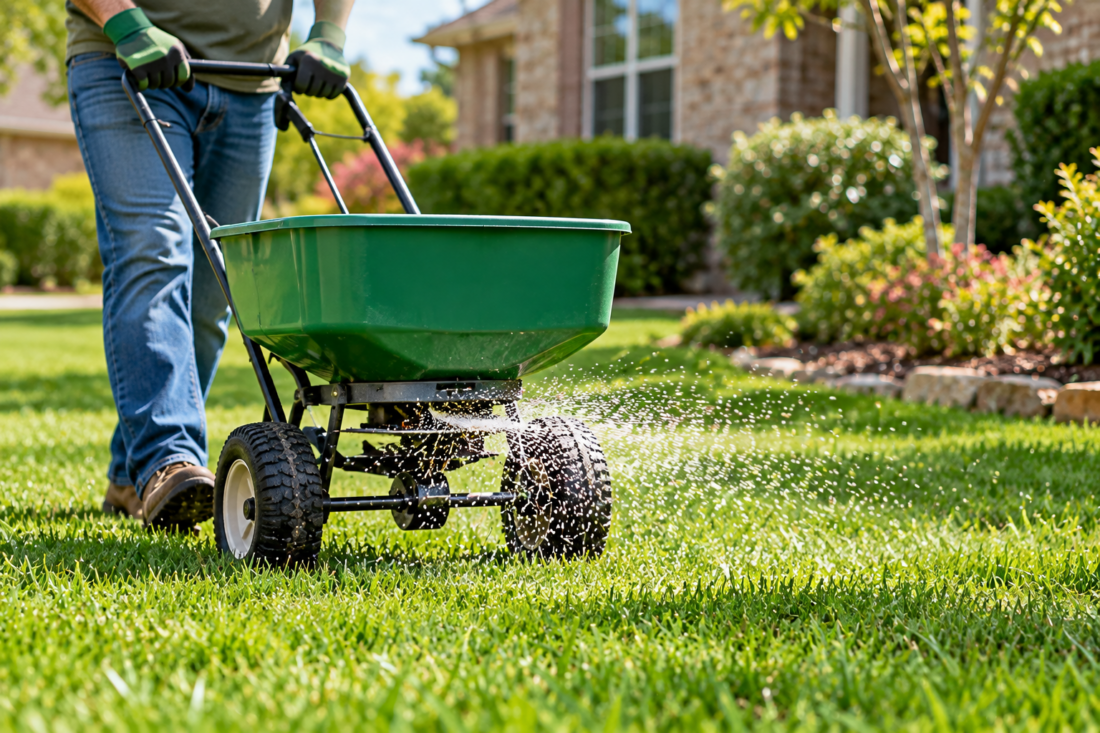
Proper fertilization can help your grass grow thicker and compete more effectively with clover. Because clover can thrive in lawns with limited nitrogen availability, correcting a nitrogen deficiency may help give your turfgrass an advantage.
However, fertilizer is not a weed killer. Adding nutrients may improve lawn health, but established clover may continue growing unless you also remove or treat it.
The right fertilizer and application schedule depend on your grass type, soil conditions, and the time of year. In North Texas, warm-season grasses such as Bermuda and Zoysia have different nutrient needs and growing patterns than cool-season grasses.
Avoid applying excessive fertilizer in an attempt to eliminate clover. Too much nitrogen can damage grass, contribute to nutrient runoff, and create other lawn problems.
A balanced lawn care program should provide the nutrients your grass needs without unnecessary applications.
For guidance on application timing, check out Ryno Lawn Care's Weed and Feed Schedule.
If weeds are also appearing in your landscaping, read our guide on how to get rid of weeds in flower beds.
2. Maintain the Correct Mowing Height
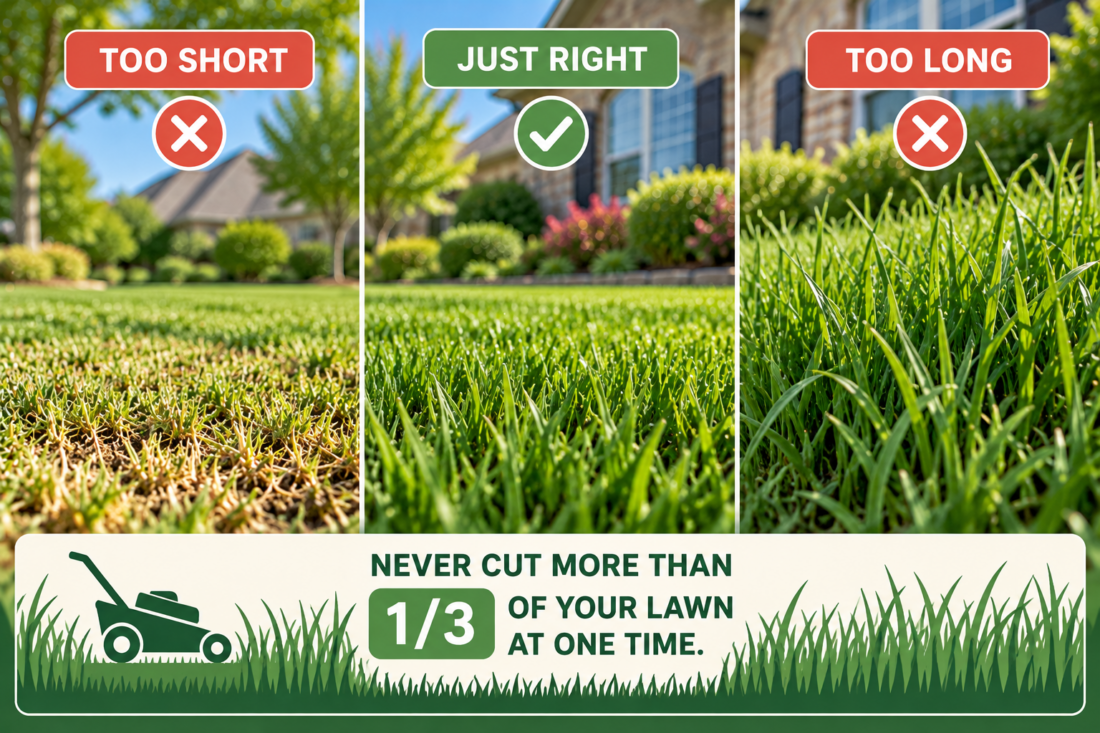
Mowing your lawn too short can stress your grass and allow weeds to take advantage of thin areas. Maintaining the appropriate mowing height helps turfgrass develop a healthier canopy that shades the soil and limits opportunities for weeds to establish.
The ideal mowing height depends on your grass variety. Bermuda grass generally tolerates a shorter cut than St. Augustine grass, for example, so a single mowing height isn't appropriate for every North Texas lawn.
Follow these mowing guidelines to help reduce clover growth:
-
Know your grass type: Set your mower according to the recommended height for your specific turfgrass.
-
Avoid cutting too much at once: As a general rule, remove no more than one-third of the grass blade in a single mowing.
-
Keep mower blades sharp: Clean cuts help minimize unnecessary stress on your grass.
-
Maintain a consistent schedule: Mow often enough to prevent the lawn from becoming excessively tall between cuts.
Proper mowing won't eliminate established clover by itself, but it can help create conditions that favor healthy turfgrass over time.
3. Remove Small Clover Patches by Hand
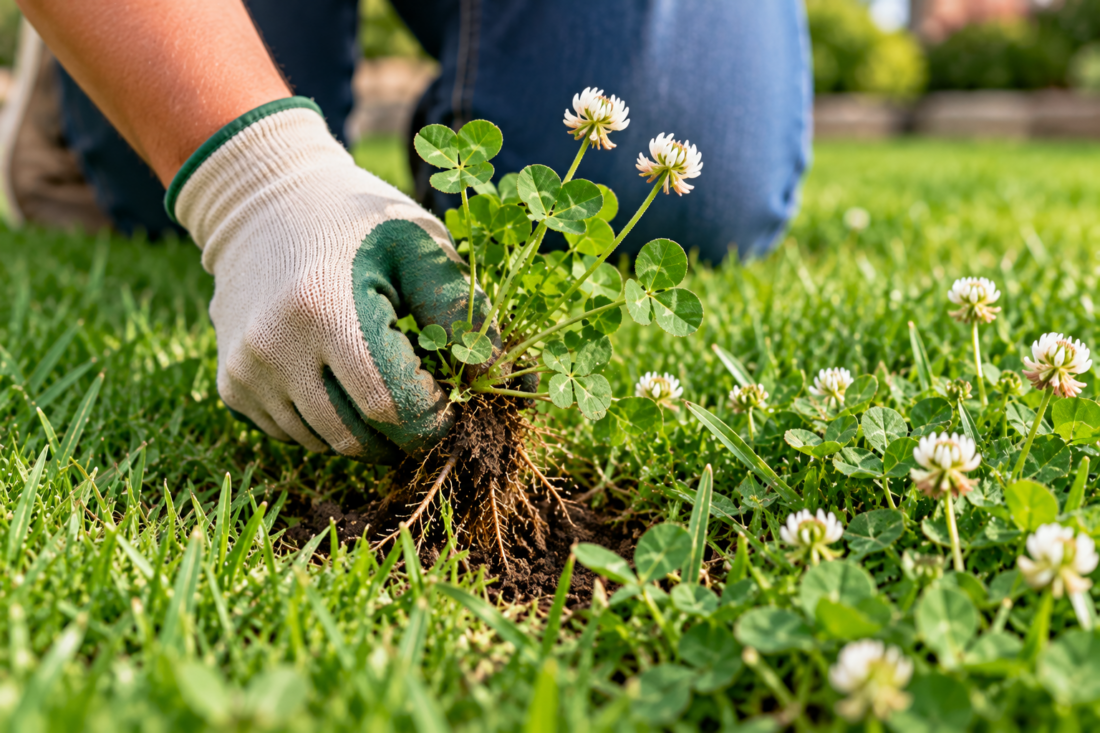
If clover is limited to a few small patches, hand-pulling can be a simple way to remove it without applying an herbicide.
For the best results, follow these steps:
-
Moisten the soil. Pulling weeds after light rain or watering can make the roots easier to remove.
-
Grip the plant near the base. Hold the clover close to the soil rather than pulling only on its leaves.
-
Remove as much of the root system as possible. Carefully loosen the soil with a hand weeding tool if needed.
-
Check the area for regrowth. Watch the treated patch over the following weeks and remove any new plants promptly.
-
Encourage the grass to fill in. Address bare or thin areas using a lawn repair method appropriate for your grass type.
Hand-pulling works best for small infestations. Because clover can spread through creeping stems and seed, removing a few plants may not be enough if the infestation is extensive.
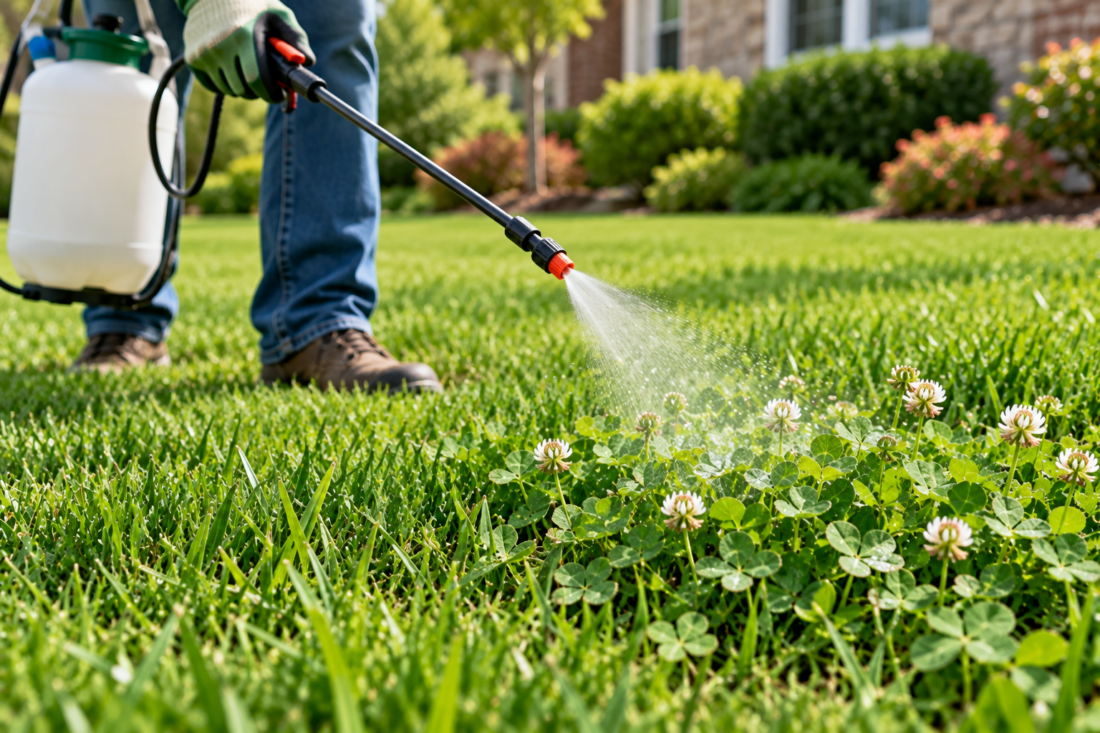
4. Use a Selective Herbicide for Established Clover
When clover covers a large portion of your lawn, a selective broadleaf herbicide labeled for your grass type may provide more effective control than hand-pulling alone.
Selective herbicides are formulated to target certain weeds while minimizing injury to compatible turfgrass when used according to the product label. However, not every product is safe for every lawn variety.
For better results:
-
Identify the clover and confirm that the product is labeled to control it.
-
Choose a product approved for your particular turfgrass.
-
Apply it during conditions and at growth stages specified on the label.
-
Avoid spraying when wind could carry the product onto desirable plants.
-
Follow all directions regarding application rates, protective equipment, watering, and restrictions for children and pets.
-
Check whether a repeat application is permitted or recommended.
Clover is generally easier to treat when it is actively growing and not severely stressed by heat or drought. In North Texas, consider current weather conditions and your grass's health before applying a treatment.
Some products may require more than one application, but never exceed the label's application limits.
For homeowners seeking to reduce herbicide use, hand-pulling and improving lawn health are alternatives for small infestations. Organic products are not automatically harmless or equally effective, so evaluate any product carefully before use.
You can also learn more about how to achieve a lush, lively, organic lawn.
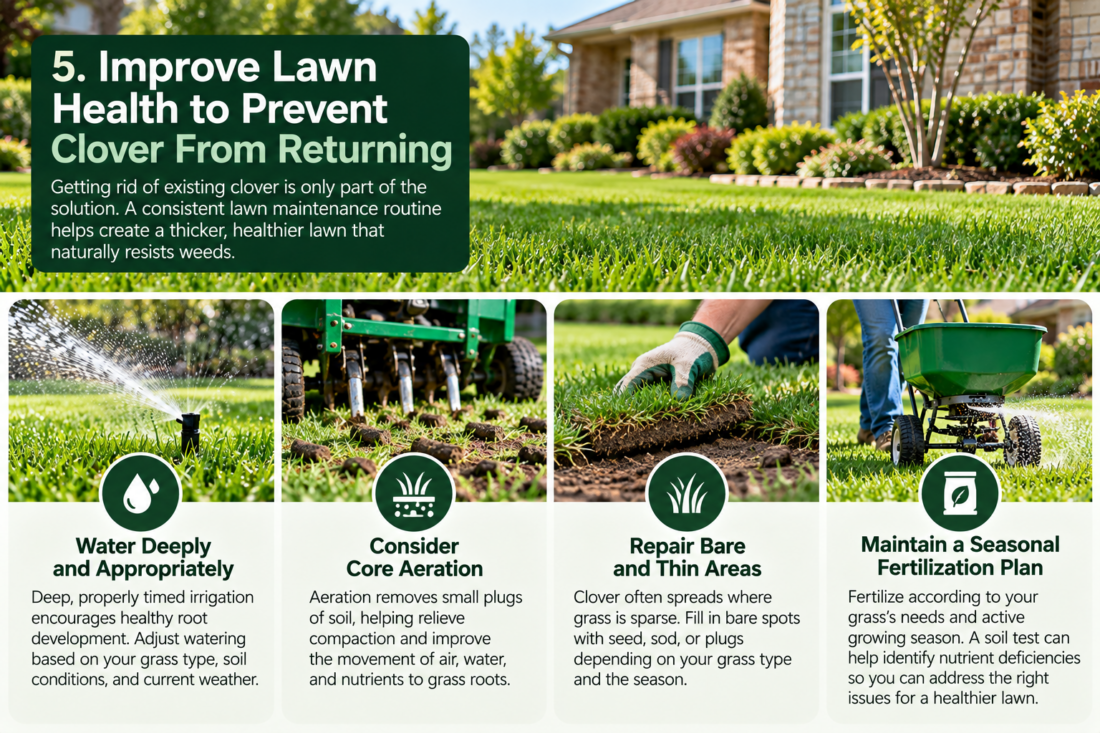
5. Improve Lawn Health to Prevent Clover From Returning
Getting rid of existing clover is only part of the solution. If your lawn remains thin, nutrient-deficient, or stressed, new clover plants may establish themselves again.
A consistent lawn maintenance routine can help reduce the conditions that favor weeds.
Water Deeply and Appropriately
Water according to your grass type, soil conditions, and current weather. Deep, appropriately timed irrigation encourages healthy root development, while frequent shallow watering can contribute to weaker roots.
North Texas summers can place significant stress on lawns, so adjust irrigation based on rainfall and seasonal conditions rather than following a rigid schedule.
Consider Core Aeration
Compacted soil can restrict root development and reduce the movement of water and air through the soil. Core aeration removes small plugs of soil, helping relieve compaction and improve conditions for root growth.
Aeration is particularly useful when compaction is contributing to poor turf health. It won't directly kill clover, but it can support a stronger lawn that competes more effectively with weeds.
Repair Bare and Thin Areas
Clover often spreads where grass coverage is sparse. Addressing bare spots can reduce the space available for weeds to establish.
Choose a repair method suitable for your grass type and the season. For warm-season grasses, sod or plugs may be appropriate in some situations, while other lawn varieties may be established through seed.
Maintain a Seasonal Fertilization Plan
Fertilize according to your grass's needs and active growing season. A soil test can help identify nutrient deficiencies and determine whether soil amendments are necessary.
Avoid assuming that every clover-infested lawn needs additional nitrogen or a pH adjustment. The goal is to correct actual problems rather than apply products unnecessarily.
For more weed management advice, see our article on what kills purslane.
Clover Control Methods Compared
The best method depends on how much clover is present, your grass type, and the underlying condition of your lawn.
| Control method | Best for | Main benefit | Important consideration |
|---|---|---|---|
| Proper fertilization | Lawns with nutrient deficiencies | Supports thicker turfgrass | Fertilizer alone won't eliminate established clover |
| Correct mowing | Routine lawn maintenance | Helps grass compete with weeds | Recommended height varies by grass type |
| Hand-pulling | Small clover patches | Avoids herbicide application | Roots and creeping stems must be addressed |
| Selective herbicide | Widespread or established clover | Targets susceptible broadleaf weeds | Product must be labeled for your turfgrass |
| Core aeration | Compacted soil | Improves growing conditions for roots | Does not directly kill clover |
| Consistent lawn maintenance | Long-term prevention | Helps maintain dense, healthy turf | Requires ongoing care |
When Should You Treat Clover in North Texas?
The best time to control clover depends on your grass type, the extent of the infestation, and the weather.
Clover is generally more responsive to treatment when it is actively growing. However, North Texas heat can stress turfgrass and increase the risk of herbicide injury, so avoid applying products under conditions prohibited by the label.
For many homeowners, a practical approach is to inspect the lawn during the growing season, treat active clover when conditions are appropriate, and continue maintaining healthy grass throughout the year.
If clover returns repeatedly, consider whether the lawn needs better nutrient management, improved soil conditions, or a different weed control strategy.
Final Thoughts: Keep Clover Under Control With the Right Lawn Care
Learning how to get rid of clover in your lawn starts with understanding why it is growing there. Hand-pulling can work for small patches, while a suitable selective herbicide may be more effective for widespread infestations. Proper fertilization, appropriate mowing, watering, and aeration can also help your grass compete with weeds.
No single treatment guarantees a permanently clover-free lawn. However, combining targeted weed control with consistent lawn maintenance can help you achieve thicker turf and reduce recurring clover problems.
Need help controlling clover and other lawn weeds? Ryno Lawn Care offers professional lawn care services to help homeowners maintain healthy, attractive lawns. Explore our lawn fertilization and weed control services
Frequently Asked Questions About Clover in Lawns
1. What is the fastest way to get rid of clover in a lawn?
For widespread clover, a selective broadleaf herbicide labeled for your grass type may provide effective control. Small patches can often be removed by hand. Improving lawn health can help reduce the likelihood of future infestations.
2. Why is clover growing in my lawn?
Clover often establishes itself in thin or stressed lawns. Low nitrogen availability, poor turf density, soil compaction, and inconsistent maintenance can contribute to its spread. A soil test can help determine whether nutrient deficiencies or pH issues need attention.
3. Will fertilizer kill clover?
No. Fertilizer does not directly kill established clover. Correcting a nitrogen deficiency can help grass grow more vigorously and compete with weeds, but existing clover may require manual removal or a suitable herbicide.
4. Does mowing help get rid of clover?
Proper mowing helps maintain healthy grass and can reduce the opportunities for weeds to establish. However, mowing alone generally won't eliminate established clover. Use the recommended mowing height for your grass type.
5. Can clover come back after treatment?
Yes. Clover may regrow from surviving plants or spread into the lawn again from seed and creeping stems. Monitor treated areas and combine weed control with lawn maintenance to reduce recurring growth.
6. Is clover bad for my lawn?
Clover isn't necessarily harmful to a lawn. It can attract pollinators and contribute nitrogen to the soil. However, homeowners who prefer a uniform grass lawn may consider it undesirable because it spreads into turf and changes the lawn's appearance.
7. When is the best time to spray clover?
Treat clover when it is actively growing, and weather conditions are suitable for the chosen product. Always follow the label's temperature, rainfall, application, and turfgrass restrictions.
8. How can I prevent clover from growing back?
Maintain dense, healthy grass with appropriate fertilization, mowing, watering, and soil management. Remove or treat existing clover and monitor the lawn for new growth. These steps can help reduce future infestations, although complete prevention isn't guaranteed.

Michelle Valdivia
Michelle brings expertise in educational communication to lawn care content creation. She holds degrees in Human Development and Family Studies and Education. Over four years, she has created professional web content for landscaping and lawn care businesses, collaborating with experienced lawn care teams to ensure each blog post is rooted in real-world expertise.